
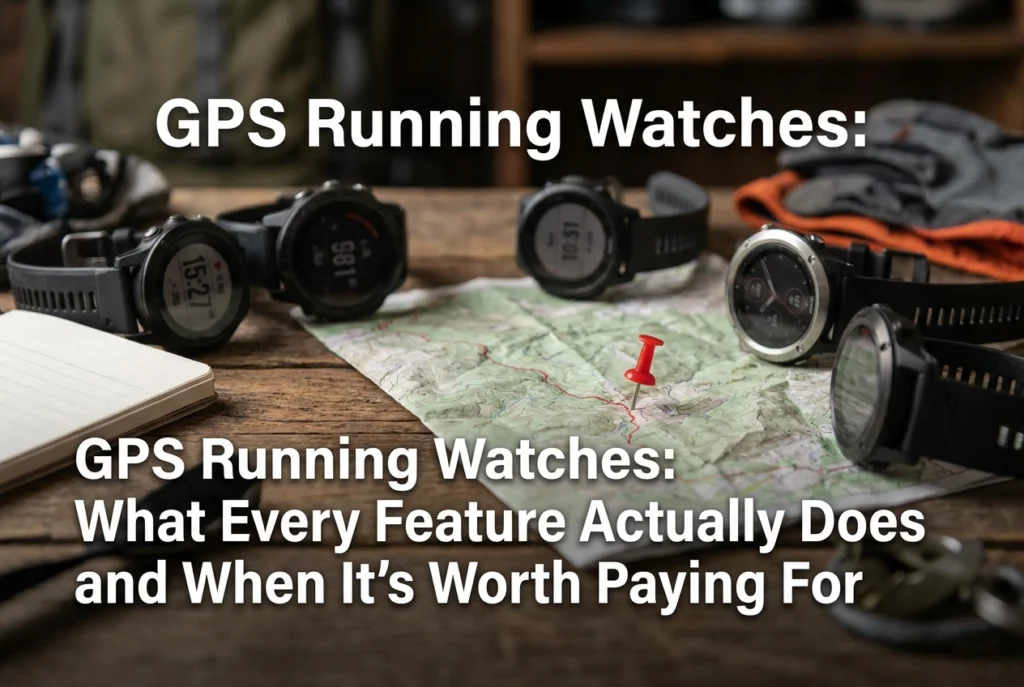
You walked into a running store, or opened a browser tab, and suddenly you were staring at a spec sheet listing twenty-three features you half-recognize and three you’ve never heard of. Recovery advisor. Running power. Ground contact time balance. At some point, someone decided that a GPS watch for running needed to do everything short of filing your taxes.
Here’s the problem: most of those features won’t change how you train. A handful genuinely will.
This guide cuts through the noise by mapping every common GPS watch feature to what it actually does for your running, and who it’s really worth paying for. You’ll learn why GPS accuracy, heart-rate reliability, and battery life are the three specs that move the needle, while most everything else sits somewhere between “occasionally useful” and “impressive on paper.” You’ll also get clear spend-threshold recommendations whether you’re just getting started, running a few times a week, or pushing into serious endurance territory.
No jargon, no brand cheerleading. Just a practical breakdown so your next watch purchase is built around your training, not a marketing team’s feature checklist.
The feature abundance trap: why more specs rarely means better running
May 2026 alone brought five new GPS watches to market from major brands. That pace of product iteration is not slowing down, and every new model arrives with a longer spec sheet than the last: satellite constellations, recovery scores, running power, ground contact time, topographic mapping, satellite messaging. The list keeps growing.
Here is what that list mostly is not: a longer list of ways to run faster or train smarter.
For the recreational runner logging 20 to 50 miles per week, three features have a consistent, direct impact on training quality: GPS accuracy, heart-rate reliability, and battery life. Everything beyond those three follows a pattern of diminishing returns, and the marketing language around those additional features is engineered to obscure exactly that. Each of those three is examined in full in the sections ahead.
This guide is written for you if you own a basic fitness tracker or an older running watch, your weekly mileage sits somewhere between 20 and 50 miles, and you are weighing a purchase somewhere in the $200 to $600 range without a clear sense of what you actually need. The sections ahead map each common watch feature to the runner profile that genuinely benefits from it, name a spend threshold at each tier, and flag the features that are legitimately useful versus the ones that exist primarily to justify a higher price point.
If you also want guidance on what to listen to once that watch is strapped on, the Enter2Run guide to running headphones: the best picks for every runner covers that ground separately.
GPS accuracy: the feature that actually changes what you do on a run
Start with the number that actually matters: recorded distance. If your GPS watch logs 6.05 miles for a route you know measures 5.88, every pace-per-mile calculation is wrong, your interval splits are off, and your weekly mileage total is quietly inflated. That error compounds across a training block.
The hardware fix is multi-band GPS (sometimes called dual-frequency). Instead of one signal frequency, it uses two simultaneously, resolving positioning errors caused by signal bounce off tall buildings, dense tree canopy, or canyon walls. Single-band chips are more susceptible to those reflected signals, which is why a runner in downtown Chicago or on a wooded trail gets messier data than one doing loops in the open.
The honest caveat: if you run road routes in open suburbs, single-band GPS is sufficient. The accuracy gap only becomes a real training problem when signal is regularly obstructed. Practitioner testing over large datasets confirms that environmental conditions drive accuracy variance far more than chip generation on open-sky courses.
At recreational training volumes, the accuracy floor for sub-$250 watches is sufficient for pace-based training on open-sky courses. For new runners building a base, those helpful gadgets do not need to cost more than $250 to deliver usable data.
A simple field test before you trust any watch’s pace data: record a run on a certified 400-meter track or flat measured segment. One lap in lane one is exactly 400 meters. If the watch is within 1 to 2 percent, it is reliable for training. If it is off by more, check your GPS settings before assuming the hardware is the problem.
When multi-band GPS earns its price: interval training where split-time precision matters, and technical trail running where signal obstruction is routine. For casual recreational running on open roads, it is genuinely the first feature where spending more returns the least.
Wrist-based heart rate: reliable enough for zone training, not for racing
Heart rate is the second feature where your watch either earns its keep or flatters you with numbers that aren’t quite right.
The sensor technology behind it is called photoplethysmography: LEDs on the watch back shine light into your skin, and a detector measures how blood volume in the capillaries pulses with each heartbeat. It works, but three things undermine it reliably. First, arm swing and wrist movement create motion artifact that the sensor reads as signal noise. Second, research into optical HR accuracy has documented that skin tone variability affects how well the LED signal penetrates and reflects, meaning the same sensor performs differently across individuals. Third, cold weather constricts blood flow away from the wrist, shrinking the signal the sensor is trying to read.
For Zone 2 runs and easy recovery miles, none of that matters much. Intensity is steady, wrist blood flow is consistent, and a well-fitted sensor on any quality GPS running watch tracks closely enough to keep you in the right zone. This is where wrist HR earns its place.
It breaks down on hard intervals, steep uphills, and cold-weather efforts. During those, reported heart rate can lag actual heart rate by a meaningful margin, enough to make a 5x1K workout look like a tempo run on your training log. If you are following a structured plan, like the kind of interval work built into an 8-week 10K training plan, that error compounds across sessions.
The practical fix is a chest strap or optical arm band. Most mid-range watches support Bluetooth or ANT+ external sensors, so you do not need a new watch, just a $50 to $80 accessory.
The wrist needs to be completely still for HRV to mean anything.
Spend verdict: Adequate optical HR comes bundled in every watch above $150. For interval training and race-day pacing, put the extra money toward a chest strap rather than a more expensive watch with a marginally better wrist sensor.
Battery life: the spec that determines whether your watch gps for running survives the event
Heart rate accuracy gets most of the pre-purchase attention, but battery life is the spec that can actually wreck a training day. A watch that dies at mile 18 of your 20-mile long run is useless regardless of how precise its optical sensor is. That is a data gap at the exact moment your pacing judgment matters most.
Real-world numbers beat headline specs every time. Manufacturer figures are measured under controlled conditions, typically with screen brightness minimized and notifications off. The Coros Pace 4 posts 41 hours in GPS mode and 19 days in smartwatch mode, figures that testing teams now treat as the mid-range benchmark. Your actual runtime will vary based on GPS mode, HR polling frequency, and music streaming, but the Pace 4 numbers are a credible reference point for comparing claims across brands.
The degradation variable most buyers ignore: lithium-ion cells do degrade with regular charge cycles; build in a buffer above the rated spec when buying, especially if you intend to keep the watch for several years.
Match your battery tier to your training volume:
- Under 50 miles per week: 15 to 20 hours GPS is sufficient
- Half-marathon and marathon training: 20 to 30 hours covers your longest efforts
- Ultra-distance or back-to-back long days: expedition-class watches with 50-plus hours or multi-week modes are the only sensible choice. The Garmin Enduro 3 prioritizes battery life above all else, using a Memory-in-Pixel display rather than AMOLED as a deliberate design trade-off, and that trade-off only makes sense above 50 to 60 miles per week.
If you are close to a budget ceiling, battery-saving settings close the gap before you spend up. Dropping from multi-band GPS to GPS plus GLONASS, reducing the GPS sampling rate, and turning off wrist HR during activities can meaningfully extend runtime on most mid-range watches. For long-distance running shoe recommendations that pair well with marathon-length training blocks, the Enter2Run guide to long-distance running shoes is worth a look before race day.
Every other feature on a GPS running watch: useful, marginal, or engineering theatre
So GPS accuracy, heart rate, and battery life are the three features that actually move the needle. Here is how to sort the useful from the marginal on everything else.
Training load and recovery metrics (body battery, training readiness, recovery advisor) aggregate HR, HRV, sleep, and recent effort into a daily readiness score. The catch: the proprietary algorithms behind these scores are not publicly documented, so treat any daily readiness number as directional rather than authoritative. Under 50 miles per week, perceived exertion and an honest answer to “how well did I sleep?” give you the same signal for free.
Running dynamics (ground contact time, vertical oscillation, stride length, left-right balance) cannot be captured accurately from the wrist alone. You need a compatible chest strap or footpod for reliable numbers. Worth it if a coach will interpret the data and adjust your training. If you will glance once and never revisit it, skip the category.
Navigation splits into two distinct features. Breadcrumb navigation traces your GPS path back to your start. Full offline topographic maps display surrounding terrain and trails you have never run. For trail runners on remote singletrack, that distinction matters. Some mid-range options, such as the Coros Apex 4, bundle full offline maps at a price point under $500, see the tier summaries below. For road runners doing neighborhood loops, topographic maps add weight and cost without changing a single workout.
LTE and satellite connectivity are safety tools, not training tools. Garmin’s inReach satellite messaging on the Fenix 8 Pro (around $1,200) works where cellular networks cannot reach, which matters for solo backcountry runners. For recreational runners on suburban roads, it is engineering you will never need.
Smartwatch hybrid features (contactless payment, offline music, notification mirroring) are useful if you wear your GPS watch all day. The Garmin Vivoactive 6 under $300 handles these without a premium price spike. That is daily-life convenience, not better running data. The best running accessories for comfort guide covers what pairs well at each training level.
The 70-miles-per-week line: where the feature calculus actually changes
All those features share one thing: their value scales with how much you run.
The 70-miles-per-week mark is a practical threshold, not an arbitrary one. Below that volume, training stress is manageable with basic feedback: distance, pace, and perceived effort. Proprietary recovery algorithms add a layer on top of signals you can already read yourself.
Under 50 miles per week, a mid-range single-band GPS watch with adequate optical heart rate and 20-plus hours of battery covers everything your training requires. Structured workout guidance and pace alerts are nice to have; offline maps and training load scores are genuinely optional. Overspending here funds features that will sit unused.
From 50 to 70 miles per week, the picture shifts modestly. If your block includes trail segments or city routes with tall buildings, multi-band GPS starts earning its cost through better split accuracy. Structured workout modes and pace alerts become useful as training grows more specific. Back-to-back weekend long runs push GPS drain toward 25 to 35 hours, where mid-range battery specs begin to feel tight.
Above 70 miles per week or into ultra-distance events, training load metrics, offline trail maps, multi-week battery, and satellite safety features move from marginal to genuinely useful. This is the tier where $500 to $800 is defensible on training grounds alone.
One honest caveat: mileage is not the only variable. A runner logging 35 miles per week on remote mountain trails has a stronger case for offline maps than a 60-miles-per-week road runner on a neighborhood loop. A data-curious runner in a coach-athlete relationship may extract real value from running dynamics at any volume. Think of 70 miles per week as a starting point, not a hard cutoff. And if high volume brings new aches, load mismanagement shows up in your body before any watch catches it. Resources like this guide on shin splints: causes, prevention, and how to get back to running are worth bookmarking before the volume climbs.
Best GPS running watch features for beginners: what to look for under $250
If you are in your first year of running, logging 10 to 20 miles per week on roads or paved paths, the mileage thresholds above do not yet apply to you. You need less hardware than most product pages will suggest.
The three things that actually matter at this tier: GPS tracking (single-band is fine), optical heart rate, and at least 15 hours of battery life in GPS mode. Everything else on the spec sheet, including running dynamics, offline maps, LTE, satellite messaging, and recovery algorithms, will not change a single training outcome at this volume.
The value case is strong here. The Coros Pace 4 (around $249) delivers GPS accuracy and battery life competitive with watches at higher price points. A beginner does not need to spend beyond $200 to $250 to get hardware that will not limit their training for the first 12 to 18 months.
If you want one device for everything, an entry-level smartwatch hybrid under $300, such as the Garmin Vivoactive 6, is a legitimate choice. You get all-day wear, notifications, contactless payment, and run tracking in a single device. Be clear on what you are buying: daily convenience packaged alongside run tracking, not better running data. The training numbers it produces are equivalent; the watch simply does more off the run.
The real spending mistake at this tier cuts both ways. Spending $500 or more on features you will not use for over a year is the obvious one. The less obvious risk is buying a non-GPS fitness tracker that records steps and heart rate but cannot log route data. That gap matters quickly once you start following a structured plan and need accurate distance and pace to hit your targets.
When you are ready to put those numbers to work, pairing your watch data with the right footwear is the next logical step. The Enter2Run guide to best running trainers for women: foot type, pace, and budget is a good place to start if you are still sorting out your shoe situation alongside your tech.
Best GPS watch features for recreational runners: the $250 to $500 sweet spot
Once you move past the beginner tier, the feature math shifts. If you’re logging 25 to 55 miles per week and building toward a half-marathon or marathon, you’re asking more of your watch: longer continuous recording, mixed terrain, pace targets for structured workouts, and the occasional 20-miler that tests every spec on the box.
The upgrade that actually matters here is multi-band GPS. On a standard marathon training block, you’re running more varied routes over more weeks than a beginner, and small GPS errors compound across long sessions. Consistent drift on tempo runs distorts your pace data and, over a training cycle, your weekly mileage totals. Multi-band GPS tightens that up, especially on city routes with tall buildings or wooded paths where single-band chips lose signal quality.
Battery life also earns more weight at this mileage. A 25-plus hour GPS rating gives you margin on back-to-back long run weekends without rationing settings or charging mid-week. Structured workout tools, meaning the ability to program interval sessions directly on the watch, are genuinely useful if you’re following a plan without a coach in your ear.
Features still marginal at this tier: full offline topographic maps (unless your training includes unmarked trail running), LTE connectivity, satellite messaging, and advanced running dynamics. Without a coach interpreting ground contact time and vertical oscillation, those numbers sit in an app unread.
The $400 to $500 range is where Garmin and Coros both hit a practical ceiling for this profile: better GPS accuracy, longer battery, and structured workout tools without the expedition and safety features that push premium watches past $800.
If you routinely run without your phone, offline music is a legitimate quality-of-life consideration. Pair that with contactless payment and you have a useful daily device, not just a training tool. For guidance on building out the rest of your gear, the Enter2Run guide to running shoes for new runners covers fit and budget in the same practical terms.
Best GPS watch features for semi-serious endurance runners: when $500-plus makes sense
Push past the $500 mark and the feature list stops being decorative. If you’re logging 55 to 80 miles per week, racing marathons or ultras, and spending real time on remote trails, several capabilities that were marginal at lower mileage become practically useful.
Multi-week battery life matters when you’re running 20-plus-hour events or back-to-back mountain days where charging is not an option. Full offline topographic maps earn their place the moment breadcrumb navigation isn’t enough because you’re on unmarked singletrack. Training load and recovery metrics become a genuine check when weekly volume is high enough that accumulated fatigue is harder to self-assess. Multi-sport modes are worth having if triathlon cross-training is part of your build.
The honest split between $600 and $1,200
For the marathon-to-50K athlete, the $600 to $800 range is the practical ceiling for training-relevant features. You get multi-band GPS, offline maps, structured workout tools, and recovery metrics without paying for hardware you don’t need.
The Garmin Enduro 3 is the right call if your primary constraint is battery, specifically 100-mile events or multi-day fastpacking where you cannot charge mid-effort. It prioritizes battery life above all else and trades some metric depth and display quality for that endurance. For most athletes at this tier, a more feature-complete watch in the $600 to $800 band serves better.
The Garmin Fenix 8 Pro at $1,200 is worth discussing plainly: the premium buys LTE and inReach satellite connectivity, allowing two-way messaging from routes with no cellular coverage. For solo mountain runners in genuinely remote terrain, that is a safety tool with real stakes. It is not a training data upgrade.
Where spending stops paying off
Garmin and Coros dominate dedicated running at this tier. The Apple Watch Ultra 3 competes strongly on smartwatch experience and daily wearability but trails on GPS battery endurance under sustained load and training-specific tools. If your priority is running performance over lifestyle integration, that gap matters.
Above $800, training-relevant features flatten. Additional spend goes toward satellite communication, premium materials, and brand positioning. Unless remote solo routes are a regular part of your schedule, $800 is the honest ceiling for training value.
A plain-language glossary of GPS watch terms that marketing overcomplicates
The terminology on a GPS watch spec sheet is designed to impress, not inform. Here are the six terms worth actually understanding.
Multi-band GPS (dual-frequency GPS): The watch receives two GPS signal frequencies at once, which helps it filter out reflected or blocked signals in urban canyons and dense trail cover. This is separate from multi-constellation support, which means the watch connects to multiple satellite networks (GPS, GLONASS, Galileo) simultaneously. Both settings improve accuracy; they work differently and are often active together.
Breadcrumb navigation: As you run, your watch plots your GPS path as a line of dots. Follow those dots in reverse and you find your way back to the start. That is the entire feature. It shows only where you have already been, not surrounding roads, alternate trails, or terrain ahead of you.
Offline maps / topographic mapping: The watch stores an actual map, including trails, roads, elevation contours, and landmarks, pre-loaded and accessible without a phone signal. Unlike breadcrumb navigation, this lets you explore routes you have never run before. It is a meaningfully different and more capable feature.
inReach: A two-way satellite messaging system built into select premium watches. It transmits text messages and your location via satellite when you are outside cellular coverage. Check manufacturer terms for service requirements. It has nothing to do with GPS positioning accuracy. It is a safety communication tool, not a navigation upgrade.
HRV (heart rate variability): The slight variation in time between consecutive heartbeats. A rising HRV trend over weeks generally signals good recovery; a sustained drop can indicate accumulated fatigue. A single daily reading tells you almost nothing. Trend data tracked over three to four weeks is where the signal becomes useful.
Training load / acute and chronic load: Your watch compares recent training stress against your longer training history to flag overreach risk. The concept is sound; the specific calculations are proprietary and have not been publicly validated against injury outcome data, so treat the output as one input among several, not a verdict.
A practical buying checklist before you choose a GPS running watch
Now that the terminology is clear, use it as a filter. Before you open a single product page, work through these six steps in order.
Step 1: Establish your weekly mileage tier. Under 25 miles, 25 to 55 miles, or above 55 miles. Pick the one that reflects your current training, not your aspirational peak week. That tier maps directly to the three buyer profiles covered earlier in this guide and tells you where your spending ceiling belongs.
Step 2: Name your primary terrain. Road, mixed road and trail, or remote technical trail. Terrain is the single strongest predictor of whether you actually need multi-band GPS and offline maps. A runner doing suburban loops needs neither. A runner navigating unmarked singletrack needs both.
Step 3: Decide on single purpose versus daily wear. A dedicated training watch lets you prioritize GPS battery and sensor accuracy above everything else. If the watch will also handle notifications, payments, and all-day wear, factor in the battery drain that smartwatch functions add and whether the design fits your daily context. These are legitimate trade-offs, not wrong choices.
Step 4: Set your budget ceiling before you read any reviews. Write the number down. Then look for the best GPS accuracy and battery life available within that ceiling. Features above those two are add-ons. Reviews written before you have a firm number tend to expand your ceiling rather than serve it.
Step 5: Confirm external sensor compatibility. Check whether the watch supports ANT+ or Bluetooth chest straps, footpods, or cycling power meters. This matters if you cross-train or want to improve heart-rate accuracy for intervals without buying a new watch later.
Step 6: Check the platform ecosystem. Garmin Connect, the Coros app, and Apple Health each have different third-party app relationships. If you use a coaching platform or share training data with a partner, verify compatibility before you buy, not after.
Spend on the features that change your training, skip the rest
Once you’ve worked through that checklist, the decision simplifies quickly. Three features determine whether a GPS running watch actually improves your training: GPS accuracy, heart-rate reliability, and battery life. Everything else scales with how many miles you run and what terrain you cover.
The spend tiers hold up across the whole market, and the three buyer-profile sections above walk through the full reasoning. Under $250 covers every training need a beginner has. From $250 to $500, multi-band GPS, longer battery, and structured workout tools arrive without the features you won’t reach. From $500 to $800, expedition battery, offline maps, and training load tools start earning their cost above 55 miles per week. Above $800, you are primarily buying satellite safety communication and premium materials, both legitimate for remote solo mountain running, neither relevant to the recreational runner logging evening road miles.
One thing worth keeping in mind: the market is moving fast. Watches available in 2026 at the entry price point offer tracking quality that would have been considered premium hardware five years ago. You are not making a compromise buy at $250; you are buying into a floor that is genuinely high.
The watch, though, only matters as much as what you do with the data. Our training plan guides at Enter2Run walk you through structured plans from 5K through marathon, and the shoe guides help you match footwear to the terrain your new watch will be mapping. GPS data without a structured plan is just numbers.
A $250 watch worn every day and used to execute a real training plan will produce better results than a $1,200 watch worn to log whatever miles felt right that morning. Consistency and structure beat hardware every time.
Conclusion
GPS running watches have never been better or more affordable, but the best watch is still the one that matches how you actually train. The features worth paying for are GPS accuracy, battery life suited to your longest efforts, and structured workout tools. Everything else is optional. Price tiers exist for a reason, and spending beyond your training volume rarely pays off.
Before you buy, know your weekly mileage, your target race distance, and your longest single run. Those three numbers point you directly to the right tier.
Then use the watch. Pair it with a structured training plan, track your progress honestly, and let the data guide adjustments. Visit Enter2Run for training plans and gear guides built around runners at every level.
The right watch, used consistently with a real plan, will always outperform expensive hardware sitting on an uninformed wrist.