
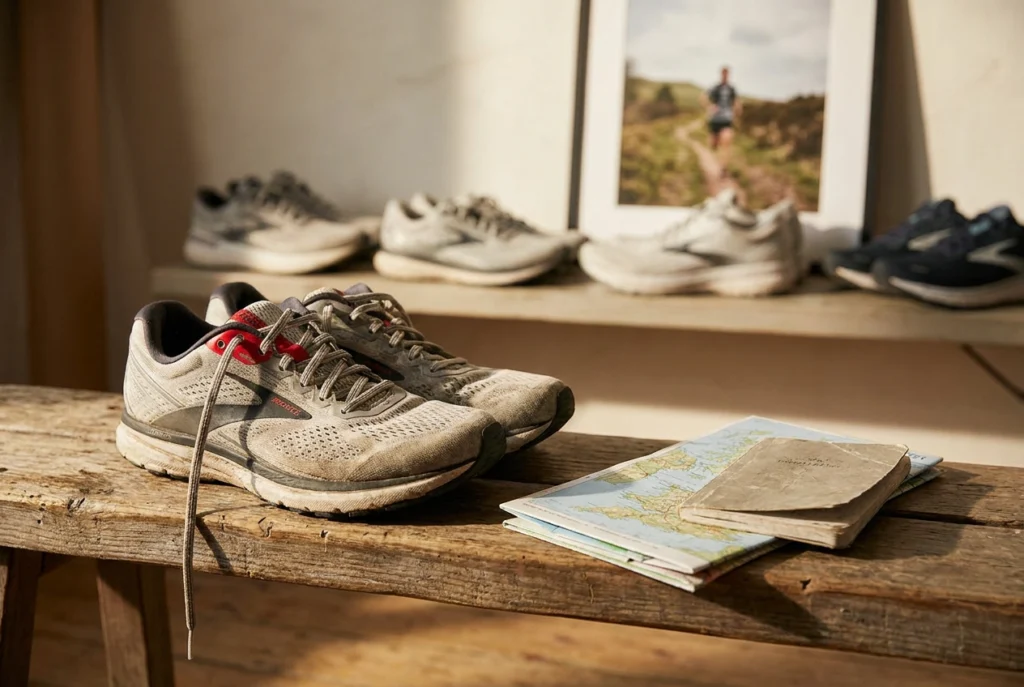
Stand in any running shop or scroll through any retailer and you will quickly find yourself staring at hundreds of options, each with its own stack height, foam compound, and stability rating. It is genuinely overwhelming, even if you have been running for years.
Here is the thing, though: most of that confusion comes from one simple mix-up. Runners tend to conflate cushioning level with support type, and once those two axes get tangled together, every shoe description sounds like the same shoe described differently. It is not. They are separate decisions, and understanding that split is the key to cutting through the noise.
This guide is built around a practical decision framework for UK road runners. Yes, we will also touch on running shoes trail and hybrid options for those who mix up their surfaces. Mostly, though, we are here to walk you through neutral versus stability geometry, daily trainer versus race-day stack, and how those four categories map to your pace, foot type, and weekly mileage. By the end, you will have a clear process for narrowing hundreds of options down to a confident shortlist of three.
The real problem with buying running shoes
Most runners arrive at a shoe purchase with a single question: neutral or stability? That question is worth asking, but it is only half the decision. The choice actually sits on two independent axes: support geometry (neutral versus stability) and cushioning stack height (daily trainer versus race-day shoe). Conflating them is the root of most buying mistakes.
Shoe marketing makes this worse, not better. A max-cushion neutral shoe gets labelled “supportive.” A firm, low-profile stability shoe gets positioned as “high performance.” Neither label tells a 10K runner logging 25 miles a week anything useful about whether the shoe matches their gait or their training load.
The practical result is that runners land in one of two traps. The first is over-relying on in-store gait analysis, which varies considerably in quality depending on the retailer, the equipment, and the staff member running the assessment. The second is defaulting to whatever they wore last time, even when their weekly mileage has increased, their gait has shifted, or the shoe’s midsole quietly gave up the ghost somewhere around 400 miles.
This guide is built around a two-axis framework that cuts through that noise. Each section narrows the field, so you finish with a shortlist of three credible options rather than a longer list of vague contenders. If you already know you overpronate and want to go straight to support options, the Enter2Run guide to stability running shoes: the right pick for your foot type and budget covers that category in full detail. But if you are not yet sure which axis-one answer applies to you, start here.
This guide is written for you if you are a recreational UK road runner with a 10K or half-marathon on the calendar, covering roughly 20 to 45 miles per week, and you have been running long enough to know what a bad shoe day actually feels like.
Axis one: neutral vs stability, and what those words actually mean
So, let’s untangle the first axis, because this is where most of the confusion starts.
“Neutral” does not mean unsupportive. A neutral shoe is built for runners whose foot rolls inward within a normal range during the loading response, the moment your foot accepts your bodyweight after heel or midfoot contact. That inward roll is healthy biomechanics. A neutral shoe provides full structural support for it; it simply does not interfere with a motion that is already working correctly.
Stability shoes do something different. They are designed to slow excessive inward roll, known as overpronation, during that same loading phase. Depending on the brand’s design approach, they achieve this through denser foam in the medial midsole, a firmer posting layer, guide rails, internal sole geometry, sole flare, or a straighter last. The mechanism varies; the goal does not.
What has changed significantly is how that goal is achieved. The traditional hard medial post of early 2000s stability shoes, a dense rubber wedge that you could feel underfoot with every step, is largely gone from current-generation models. Modern stability shoes use graduated foam densities and guide rail systems that sit along the sides of the heel and midfoot. Crucially, those rails engage only when the foot deviates from its optimal path. A runner with a stable midstride simply does not feel them. If you tried a stability shoe five years ago and found it stiff or plodding, it is worth reassessing: several current models sit at the same stack height and use foam compounds as responsive as their neutral equivalents. The “stability shoes are heavy and rigid” assumption is increasingly a myth rather than a reliable rule. (For a category-by-category breakdown that includes stability options, the best running trainers for women guide on this site shows how that separation plays out across specific models.)
One more thing worth naming: underpronation, or supination, is far less common than shoe marketing suggests. It does not automatically call for a specialist shoe, but it does mean staying firmly in neutral geometry rather than moving toward stability, where the midsole structure would work against your natural motion.
The practical question for this axis is straightforward: does your foot roll inward past the midpoint of the stance phase? A treadmill gait assessment at a specialist running retailer, or an appointment with a running-specific physiotherapist, will give you a reliable answer. A static arch test or a wet-foot print on paper will not, because arch height and gait pattern are not the same variable. Get the moving picture, not the still one.
Axis two: cushioning stack, daily trainer vs race-day geometry
Once you have your axis-one answer sorted, the second axis is where a lot of runners get caught out again, because cushioning level and support type are completely independent of each other. You can need a high-stack neutral shoe, a low-stack neutral shoe, a high-stack stability shoe, or a low-stack stability shoe. All four are legitimate combinations. Conflating the two is what produces the frustrated runner who bought a firm stability shoe thinking “more support means more cushioning” and ended up with sore legs after a long Sunday run.
Daily trainers are built for repetition. Current-generation models typically sit in the 35 to 42mm heel stack range, use softer foam compounds that absorb load over multiple sessions, and offer more generous toe boxes to accommodate foot swell across a week of training. The job of a daily trainer is not to feel exciting; it is to still feel consistent on session four of the week when your legs are already carrying fatigue.
Race-day and faster-workout shoes work from a different brief. Rather than maximising protection across high mileage, they prioritise energy return and ground feel. That means firmer or more propulsive foam, carbon or nylon plate geometry in many current designs, and a last tuned to a faster cadence. Runners following a structured programme will recognise that tempo sessions and race day both demand something different from the shoe underneath them.
Mileage is your clearest signal for whether you need both types. Under 25 miles per week, a single well-chosen daily trainer handles everything comfortably. Above 40 miles per week, rotating a daily trainer with a faster shoe protects the foam of both shoes and reduces cumulative leg load across the week.
One important clarification: stack height alone does not make a shoe a good daily trainer. Outsole rubber durability, midsole resilience across 300 to 500 miles, and upper fit quality matter just as much for a runner doing four sessions per week. A high-stack shoe built with low-grade rubber and a narrow upper will let you down well before the midsole gives out.
This is also the axis where road and trail design part company sharply. Road geometry and smooth-surface outsole compounds are not engineered for off-road terrain. If your routes include trail sections and you are weighing up running and trail shoes as a crossover option, that is a separate decision covered in our dedicated trail shoe guide on this site.
The four categories mapped out
Those two axes give you four distinct categories. Every road running shoe on the market fits into one of them.
Category 1: Neutral daily trainer
The workhorse of most runners’ rotations. It suits a neutral or supinating gait, handles three to five sessions per week, and covers easy jogs to steady tempo. Heel stack typically sits between 35 and 40mm in current models. If you run 20 to 50 miles per week with no confirmed overpronation, this category should absorb the bulk of your training mileage and is where your budget should be weighted first.
Category 2: Stability daily trainer
Same mileage range and frequency, built for mild to moderate overpronation. Modern stability shoes use guide rails, dual-density foam, or internal sole geometry rather than the rigid medial post that defined the category a decade ago. Research into motion control shoe design confirms these structures measurably reduce tibial rotation during the loading phase. If you tried a stability shoe five or more years ago and found it heavy or stiff, current models feel considerably closer to a neutral trainer than that experience suggests.
Category 3: Neutral race-day or fast-workout shoe
For neutral-gait runners who want something sharper for parkrun, tempo sessions, or race day. Expect a carbon or nylon plate, a more propulsive foam compound, and geometry tuned to faster turnover. This is not a daily trainer and should not replace one.
Category 4: Stability race-day or fast-workout shoe
A smaller but growing category: stability geometry built into a performance platform, for overpronating runners who want race-day speed without losing support. Worth noting specifically because this category did not meaningfully exist five years ago.
The matrix in practice
Your daily trainer and race shoe should match on the neutral/stability axis and differ on the cushioning/speed axis. The error to avoid: training in a stability daily trainer and racing in a neutral carbon shoe because it is faster. That switch removes support at exactly the moment fatigue sets in, one of the more predictable causes of race-day foot and lower-leg discomfort, alongside training load spikes that can develop into problems covered in this guide to shin splints: causes, prevention, and how to get back to running. Match the axis, change the stack.
Mapping the framework to pace, foot type, and weekly mileage
Knowing which category you need is one thing. Knowing which variables within that category should guide your final choice is what separates a shoe that works from one that gathers dust after six weeks.
Pace and loading time
Slower paces mean more time in the loading phase per stride. If your easy miles sit between 9 and 11 minutes per mile, a well-cushioned daily trainer earns its place by absorbing that extended ground contact across every session. Runners hitting sub-8 minute miles generate higher impact forces but at a faster cadence with less dwell time per stride. A firmer, more responsive foam handles that load more efficiently than a soft compound, which is why faster runners often find max-cushion shoes feel sluggish rather than comfortable.
Gait pattern, not foot shape
The neutral-versus-stability decision comes down to how your foot moves during the loading response, not what it looks like standing still. A high arch does not guarantee a neutral gait, and a flat foot does not automatically mean overpronation. A treadmill gait assessment at a specialist running retailer is the most useful single step any UK runner can take before committing to a purchase. Follow it by trying at least three models from the shortlisted category. (If you are still building your understanding of what to look for, our guide to buying your first pair of running shoes walks through the process from the beginning.)
Mileage thresholds
Under 20 miles per week, one well-fitted daily trainer handles everything. Between 20 and 40 miles, a second faster shoe for quality sessions becomes a useful addition. Above 40 miles, rotating two shoes is strongly advisable: midsole foam needs 24 to 48 hours to decompress fully between sessions, and running on compressed foam is effectively running in a shoe one category softer than you selected.
Body weight and stack height
Runners above roughly 85 to 90kg often find higher-stack, more resilient midsoles distribute load more comfortably on long runs, regardless of gait pattern. A heavier runner with a neutral gait still needs a neutral shoe, but one with a more robust midsole compound rather than the softest foam in the range.
Training phase
Your shoe emphasis should shift as the season progresses. Building base in January, durability and protection take priority. Two weeks out from race day, the same runner wants responsiveness, reduced weight, and a shoe already broken in. Choosing shoes with that timeline in mind keeps your kit matched to what your training actually demands.
Worked examples across budget tiers
The framework becomes clearest with real runners. Here are three profiles covering the most common buying decisions UK road runners face.
Persona A: returning runner, neutral gait, 22 miles per week
Budget: £80 to £110. A single neutral daily trainer is the right call. You do not need a rotation yet or sophisticated foam. Look for a heel-to-toe drop of 8 to 10mm, a generous toe box that does not let the foot slide, and outsole rubber covering both the heel strike zone and forefoot fully. Entry-to-mid pricing gives access to well-engineered previous-season models, and at 22 miles per week, last season’s foam is perfectly adequate.
Persona B: club runner, mild overpronation, 38 miles per week
Budget: £110 to £160 for the daily trainer, £160 to £220 for race day. Mild overpronation fixes the support axis: stability throughout. A neutral race shoe is not an option regardless of how light it looks. For the daily trainer, choose a modern guide-rail or dual-density design rather than a traditional rigid medial post. For race day, stay within the same brand family where possible. The geometry transition is more predictable when the stability platform shares an engineering lineage.
Persona C: recreational marathoner, neutral gait, 48 miles per week
Budget: £160 and above per shoe. Three shoes, three roles: high-stack neutral trainer for easy and long runs, lower-stack neutral trainer for medium efforts, carbon-plated neutral shoe for the marathon itself. The carbon shoe earns one or two sessions per week in the final six weeks of build, not a permanent rotation slot. Using it for every session dulls the proprioceptive novelty you want on race day.
Budget band summary
Under £90 gets previous-generation models that are entirely respectable for runners under 30 miles per week. £90 to £140 covers the majority of current-season daily trainers in both neutral and stability categories. £140 and above is where carbon-plated race shoes and advanced foam compounds sit. The performance gain at the premium end is most meaningful for runners faster than roughly 40 minutes for 10K.
One practical note for UK buyers: several US-market models arrive here on a different seasonal cycle, and colourway ranges often differ. Before committing between two shortlisted shoes, check current stock on the brand’s own UK site. Choosing a shoe that turns out to be unavailable in your size is an entirely avoidable detour.
How to narrow to a shortlist of three
The personas above illustrate the framework in action. Here is the same logic condensed into five steps you can run through in under an hour.
Step 1: Settle your neutral or stability answer first. Get a treadmill gait assessment at a specialist running retailer, not an arch-height test and not the wet-footprint method. Neither static test tells you what your foot does during the loading phase of your stride. If you have had a running-related foot or lower-leg injury in the past 12 months, speak to a physio before committing to a category. Shoe selection is a useful tool; it is not a substitute for a professional assessment of an existing problem.
Step 2: Decide how many shoes you need. Answer two questions: what is your weekly mileage, and do you have a target race within the next 16 weeks? If your mileage sits under 25 miles per week and there is no race on the calendar, a single daily trainer is the right call. If you are above 40 miles per week or have a half-marathon or marathon approaching, a two-shoe rotation earns its cost.
Step 3: Set your budget for the full picture, not just one shoe. A £200 budget allocated entirely to a carbon-plated race shoe leaves you training in whatever is already on your feet. For a runner doing four sessions per week, that is a poor trade. Split the budget in proportion to how often each shoe will be used. The daily trainer absorbs 80 percent of your mileage and deserves the larger share.
Step 4: Filter by category, then identify three models. Your category is now fixed: neutral daily, stability daily, neutral race, or stability race. Use the Enter2Run shoe review index, filtered by foot type and use case, to identify three models within your budget band. Three gives you genuine comparison; one gives you confirmation bias.
Step 5: Try all three in-store before buying. Wear your usual running socks and the lacing style you actually run in. A shoe that fits your foot volume correctly will outlast one that felt exciting standing still but produced hotspots at the 45-minute mark. Having three shortlisted options also protects you if your first choice sells out mid-season, updates its last geometry, or is unavailable in your half-size. While prepping for race day, sort the rest of your kit too, including running shorts that suit your distance and body, so nothing distracts you on the day itself.
Common mistakes and how to avoid them
Even after you’ve followed the five-step shortlisting process, a handful of persistent habits can undo a well-reasoned choice. Here are the ones that crop up most often.
Mistaking a snug upper for stability geometry. A well-fitted heel counter and a neatly laced midfoot can make any shoe feel secure, regardless of what the midsole is actually doing. That “locked-in” sensation in-store is often upper construction, not pronation control. The fix is straightforward: try a neutral and a stability model in your correct size with your usual lacing, and compare them back to back rather than relying on first impressions of either in isolation.
Chasing the newest foam. Foam compounds do improve across generations, and the gains are real. But a previous-season model in the correct category for your gait will outperform a current-season model that is the wrong shape for your foot. If the fit and geometry are right, the marginal foam upgrade rarely justifies the full price premium.
Racing in a shoe with no training miles on it. Blisters and midfoot fatigue on race day are almost always preventable. Log at least four to six sessions in any shoe before you pin a race number on. That applies to carbon-plated shoes as much as anything else: the geometry and stack height are different enough from a daily trainer that your feet need time to adapt.
Using road shoes on mixed-terrain races. If your event includes trail sections, even relatively tame ones, road shoes lack the outsole grip and lateral stability that uneven ground demands. The result is both an injury risk and accelerated shoe wear. Road geometry and trail geometry are separate purchases, and the difference matters more on a wet October cross-country course than it does on a dry gravel towpath.
Ignoring midsole wear. The outsole can look perfectly intact while the midsole foam has compressed significantly, typically somewhere between 300 and 500 miles. At that point, the geometry you originally selected for your gait no longer exists in the shoe. Date your shoes from purchase and use the mileage tracker on your running watch (most current GPS watches do this automatically) to stay ahead of it. If you are newer to tracking mileage and pace data, the principles in our Couch to 5K plan: your complete beginner’s guide cover how to build that habit from the very first session.
A note on trail and hybrid options
One caveat before closing out the road shoe framework: not every UK run stays on tarmac, and it is worth being clear about where road shoes stop being the right tool.
Many routes that feel like “a bit of trail” are actually within the tolerance of a well-built road daily trainer. Crushed-gravel paths, canal towpaths, and the packed-dirt surfaces you encounter at most parkrun events put minimal demand on grip beyond what a standard carbon-rubber road outsole handles comfortably. Where road shoes genuinely fail is on technical off-road terrain: wet roots, deep mud, loose rock, and waterlogged fell paths. On those surfaces, the outsole compounds and stack geometry that work well on asphalt become a liability.
Dedicated trail shoes are a different product category, not simply a road shoe with a grippier sole. The outsole uses lugged rubber designed to bite into soft or uneven ground; the stack is typically lower and more stable to improve proprioception on uneven terrain; and the toe box is reinforced to handle rock strike and root impact that would damage a road shoe upper inside a few outings.
True hybrid shoes sit between these two categories and are a practical answer for a UK runner whose weekly training splits roughly 60 to 70 percent road and 30 to 40 percent light off-road. They compromise slightly on road cushioning relative to a dedicated road trainer, and slightly on grip relative to a dedicated trail shoe, but they handle mixed-terrain routes as a single-shoe option without the cost or complexity of maintaining two separate pairs.
One thing that does not change when you leave the road: the neutral versus stability axis. An overpronating runner does not stop overpronating on a forest path, and several trail and hybrid shoe ranges now include stability variants of their core models alongside their neutral versions.
If your training regularly mixes road and off-road miles, apply the same two-axis framework here. Assess gait first, then find the trail or hybrid model within the neutral or stability category that matches the geometry of your road shoe.
Conclusion: your decision framework on one page
The same two-axis logic that applies to road shoes applies to trail and hybrid choices. Whatever terrain you run on, the framework travels with you.
Here is the whole decision in four steps. First, confirm your gait pattern through a treadmill assessment: that single answer places you in either the neutral or stability column and stays fixed regardless of how much you run or how fast. Second, look at your weekly mileage and race calendar: those two numbers tell you whether you need a daily trainer, a race-day shoe, or both. Third, set an honest budget that accounts for the full rotation you actually need, not just the most exciting shoe on the shelf. Fourth, identify three models that land in the correct category within that budget, try them in-store with your usual socks and lacing, and choose the one that fits your foot volume best rather than the one that generated the most excitement on a five-minute treadmill run.
That process, four steps and four categories, is a more reliable path to the right shoe than any generic “best running shoes of the year” list, because those lists rank shoes without knowing your gait pattern, your mileage, or your budget.
One important caveat: if you are currently experiencing foot, ankle, or lower-leg pain, speak to a physio or sports medicine physician before applying this framework. Shoe selection is a practical tool for healthy runners making training decisions. It is not a substitute for professional assessment of an injury.
When you are ready to shortlist, use the Enter2Run shoe review index. It is organised by foot type, terrain, and use case, and every recommendation is assessed against a consistent fit-and-mileage protocol rather than brand relationships. Cross-reference your three shortlisted models there, and you will go into any shop or checkout with a clear idea of what you are looking for and why.