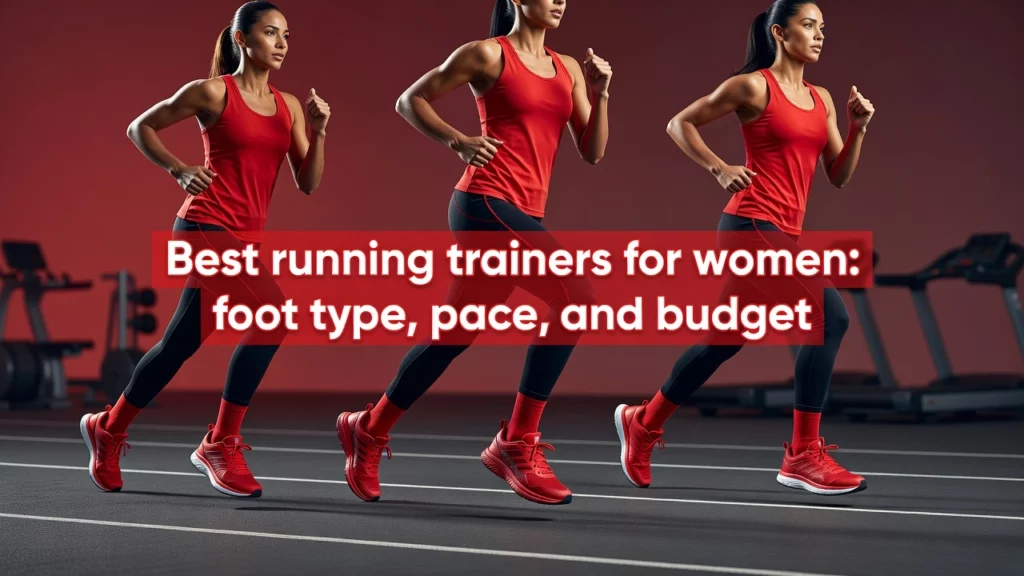
So you’ve decided to start running. Amazing! But now you’re staring at a wall of trainers online, completely overwhelmed by cushioning levels, pronation charts, and price tags that make your eyes water. Sound familiar?
Here’s the truth: finding the right running trainers womens styles included, doesn’t have to be complicated. The perfect pair is out there for you, whether you’re just starting out with gentle jogs around the block or already dreaming about your first 5K.
The problem is that most guides are written for seasoned runners who already know their gait analysis results by heart. This one is different. We’ve broken everything down in plain, simple terms so you can shop with confidence rather than confusion.
In this post, you’ll discover how your foot type affects which trainers suit you best, how your pace and running goals should shape your choice, and which options work across a range of budgets. By the time you reach the end, you’ll know exactly what to look for and have a solid shortlist of recommendations to get you started. Let’s find your perfect pair.
If you’ve never bought a running shoe before, start here
Before you look at a single shoe model, three decisions will do most of the work for you: support type, terrain, and fit. Get these right first, and the rest of the guide becomes much easier to navigate.
Support type comes down to neutral versus stability. Neutral shoes offer even cushioning and let your foot move through its natural stride without any structural intervention. Stability shoes include firmer foam or built-in guide rails along the arch to support runners whose feet roll inward significantly on impact (this is called overpronation). If you have no idea which category describes you, that is completely normal for a first-time buyer, and it is exactly why the next point matters.
A gait assessment at a specialist running store is worth 20 minutes of your time. A staff member will watch you run, often on a treadmill, and can tell you whether you need stability features or whether a neutral shoe suits you fine. You are not obligated to buy on the spot, but the information you walk out with is genuinely useful. If you want more background before you go, this complete guide to running shoes covers the terminology in plain language.
Terrain is the second filter. Road shoes handle pavement, tracks, and treadmills. Trail shoes have grippy outsoles for dirt, mud, and uneven surfaces. Most beginners start on roads, so most entries in this guide are road-focused.
Fit is the third. Your shoe should feel comfortable the moment you lace it up. Running shoes do not need a break-in period. Look for a thumb’s width of space between your longest toe and the end of the shoe, enough width so your forefoot is not squeezed, and a heel that holds without slipping. Try them on with the socks you plan to run in.
To use this guide: skim the use-case headings below, find the one that sounds like your running right now, and start there. You can always read the others once you have a first pair on your feet. Runner’s World’s beginner shoe guide is also a solid reference if you want a second opinion alongside our picks.
How women’s running shoes differ from men’s versions
The shoe you pick off the shelf in the women’s section is not simply a smaller, differently coloured version of its men’s counterpart. At least, it shouldn’t be. Understanding what separates a well-engineered women’s shoe from a resized men’s one will help you make a much smarter first purchase.
It starts with the last
A last is the foot-shaped mould around which a shoe is built, and a true women’s-specific last reflects real differences in average female foot geometry. Women’s lasts are typically built with a narrower heel cup, a lower-volume upper through the midfoot, and a forefoot that is proportionally wider relative to overall shoe length. You might not notice these differences on a shelf, but you will notice them on a run: a heel that slips slightly, a midfoot that feels loose, or toes that feel squeezed are often signs that the last was not designed for your foot shape.
The Q-angle question
Women generally have a wider pelvis than men, which creates a greater Q-angle, the angle formed where the femur meets the tibia at the knee. This influences how force travels through the leg on impact and is one of the reasons some women feel a women’s-specific model fits their stride more naturally than a scaled-down men’s version. A 2024 peer-reviewed study in Bioengineering examined exactly these gender differences in running dynamics and how footwear interacts with them. This is general anatomical context, not medical advice. If you have knee discomfort or pain, please speak with a physio before buying.
“Shrink and pink” is a real problem
Not every brand builds a genuine women’s-specific last. Some simply scale the men’s shoe down by a size or two, adjust the colour palette, and call it done. The result tends to feel imprecise in the heel counter and midfoot, where the proportions are still based on male foot geometry. Research into gender differences in running shoes confirms that women are more than scaled-down men, and that footwear engineering ideally reflects that. When you try a shoe and the heel feels roomy despite the correct length, or the midfoot sits loosely, a scaled-down last is often the culprit.
When a men’s model might actually fit better
Your individual foot shape matters more than any category label. Women with wider feet, higher arches, or larger shoe sizes (typically US 11 and above, where women’s options thin out quickly) sometimes find a better fit in men’s versions of certain models. Men’s shoes in the same line generally run about 1.5 sizes larger than the equivalent women’s size, so a women’s US 11 would correspond roughly to a men’s US 9.5 as a starting point. If you decide to compare, check the heel fit first: a men’s last will usually have a wider heel than the women’s equivalent, which is either the solution or the problem depending on your foot.
The practical approach
Start with the women’s-specific version. Try it on with your running socks, jog a few steps if the store allows it, and pay attention to how the heel and forefoot feel independently. If something feels off and length is not the issue, try the men’s equivalent or ask the fitter about a wide-fit women’s option. For fit problems that come with discomfort or pain, a physio or specialist running fitter is the right next step, not another pair of shoes.
Best for new runners: a forgiving daily trainer
This section is for you if you’re working through your first 5K plan, coming back to running after a break of a year or more, or simply putting in easy miles on roads and local paths. You are not training for speed right now. You need a shoe that keeps you comfortable enough to show up for the next run.
What that means in practice: a plush but stable midsole that absorbs impact without feeling wobbly underfoot, a heel cup that holds your foot in place from the first minute to the last, and an upper that creates zero pressure points during a 30-minute outing. If any one of those three things is missing, the shoe will work against you before your fitness even has a chance to build.
This is where high-stack foam construction earns its reputation. Models in the current generation of the Saucony Ride and Asics Novablast lines use thick, energy-returning midsoles that do real work during the heavy, fatigue-phase landings that are completely normal for newer runners. You are not landing inefficiently because something is wrong with you. You are landing that way because your body is still learning, and extra cushioning bridges that gap. Independent testing on daily trainers consistently confirms that softness and shock absorption are the primary design goals of this category, which aligns exactly with what a beginner training load requires.
The honest trade-off is weight. Maximum-cushion trainers are heavier than performance shoes. For easy runs of 20 to 40 minutes, you will not notice this difference. It only becomes relevant if you plan to race later and want something lighter on race day, which is a problem worth having and easy to solve when you get there.
Before you commit to any shoe, use this simple criterion: put them on, head out at easy pace for 20 minutes, and pay attention to two things only. Is there any heel slippage? Are there any hot spots across the forefoot? If the answer to both is no, you have a strong candidate for your first pair. OutdoorGearLab’s testing protocol runs 50-plus miles in every shoe before publishing a verdict, which is a professional version of exactly the same logic: fit problems reveal themselves through movement, not through standing in a store.
Best everyday daily trainer: the workhorse of your week
This category is for you if you’re running three to five times a week, mixing easy aerobic miles with the occasional tempo effort, and you want a single shoe that handles all of it without drama. You’re past the pure beginner stage but you’re not yet rotating a dedicated speed shoe alongside a long-run shoe. You need one reliable partner that shows up the same way every single time.
What separates a genuine daily trainer from everything else comes down to three things we look at closely: outsole rubber durability across varied surfaces (roads, wet paths, the odd gravel stretch), foam resilience after repeated compression, and upper breathability over longer distances. That foam question is the most important one. A shoe can feel plush on run one and noticeably flat by run thirty if the foam compound doesn’t rebound well. The shoes worth recommending here feel consistent across a full mileage cycle, not just fresh out of the box.
Three models consistently earn their place in this category. The Asics Novablast 5 delivers a high-stack, bouncy ride that holds up well over accumulated miles. The Hoka Mach 7 sits at a mid-range price point and is one of the best-value daily trainers currently available, offering a smooth, balanced ride that suits mixed-pace training. The Brooks Glycerin 23 is the plush, high-mileage option that Runner’s World’s 2026 testing panel specifically identifies as the women’s preference in the Brooks lineup, thanks to its reliable cushioning and well-structured fit across longer efforts.
The honest trade-off: a great daily trainer is not an exciting shoe. It is not supposed to be. The foam geometry that protects your legs across back-to-back sessions is deliberately different from the snappy, propulsive feel of a tempo or race shoe. If you want that feeling, a dedicated speed shoe gives it to you. The daily trainer’s job is consistency, protection, and longevity, and the best daily trainers do exactly that without asking you to think about them.
One practical note: if you’re running four or more times a week, buy two pairs of whichever model you choose and alternate them. Foam needs 24 to 48 hours to decompress after a run. One pair used daily means you’re always running on partially compressed cushioning. Two pairs in rotation extends total lifespan and keeps the ride consistent from session one to session fifty.
Best for wide feet or a roomy toe box
This one is for you if you’ve ever finished a run with a black toenail, a hot spot across the ball of your foot, or that familiar pinching pressure at the bunion joint. You might have a genuinely wide foot, or you might have a forefoot that’s wider than your heel, which is actually a very common foot shape in women and one that standard shoe lasts handle poorly. Women with bunions, hammer toes, or simply broader metatarsals often find that conventional women’s running shoes feel fine in the store but become progressively more painful as mileage climbs.
Why the standard women’s last works against you
Most mainstream brands build their women’s shoes on a D-width last. That is considered standard, but biomechanics research published in Gait and Posture found that runners in poorly fitting shoes showed higher rates of blisters, metatarsalgia, and hallux valgus progression. When your foot is wider than the last it’s housed in, the upper compresses your metatarsals on every stride, and the problem compounds over distance. Some brands do offer 2E and 4E widths, but those wider versions are frequently only available online rather than in-store, which makes fit-testing tricky.
How to tell if a shoe actually fits
When you try on a wide-fit or foot-shaped shoe, do a quick standing check before you run a step. All five toes should be able to spread without pressing into the upper. The fabric across the widest part of your foot should lie flat, with no visible creasing or strain. Then run in them, ideally for at least 45 minutes, because bunion-related friction and forefoot pressure often only appear once the foot has warmed up and spread under load.
The foot-shaped last option
Brands like Altra build their entire range around a foot-shaped last, meaning the toe box follows the natural outline of your foot rather than tapering toward the big toe. The Altra Experience Flow (current generation) is the model cited most consistently in 2026 wide-foot running shoe guides as the default recommendation for this foot type. It is also worth noting the distinction between ordering a standard shoe in a wide size versus choosing a shoe built on a genuinely foot-shaped last: these are not the same thing, and many women try the first option without success before discovering the second.
The transition you need to plan for
Zero-drop models, including most Altra shoes, place your heel and forefoot at the same height. If you are coming from a conventional shoe with an 8 to 12 mm heel-to-toe drop, your calves and Achilles tendon will be taking on load they are not yet conditioned for. Start with your two shortest runs each week in the new shoes, keep those runs easy, and build volume gradually over four to six weeks. If you notice calf tightness or Achilles soreness during that process, back off and speak to a physio before continuing. This is general guidance, not a substitute for professional assessment of any pain or injury.
Best stability shoe for overpronation
This section is for you if your arches roll noticeably inward when your foot hits the ground, a movement pattern called overpronation. You might already suspect it if a previous pair of running shoes wore down heavily on the inner heel and the inner edge of the forefoot. Or you may have had it confirmed during a gait assessment at a specialist running store, which is the most reliable way to know for sure. Either way, a stability shoe is worth considering.
What the support actually does
Stability shoes use structural features built into the midsole to slow that inward roll without locking your foot into an unnatural position. The three most common approaches you’ll see in current-generation shoes are a medial post (denser foam on the inner side of the midsole), a guide rail system that lines both sides of the shoe and gently steers your foot, or an internal geometry framework that guides your gait through each stride. Each brand has its own version. Brooks uses Guide Rails in the Adrenaline GTS, Asics uses a 4D Guidance System in the Kayano line, and Saucony uses a traditional medial post with updated foam geometry in the Guide series. The goal of all three is the same: support without overcorrection. One important note, and this applies to anyone reading: if you are experiencing pain in your knees, hips, or feet that you suspect is linked to your gait, please see a physiotherapist before choosing a shoe. General information about shoe design is not a substitute for that conversation.
How to test one properly
When you try a stability shoe, the key thing to notice is whether it feels guided or rigid. Guided means your foot moves naturally but with a subtle sense of direction. Rigid means the shoe is pushing back against your foot’s motion, which can feel uncomfortable and may indicate the correction level is too aggressive for your specific gait. As the Doctors of Running stability guide notes, overpronation exists on a spectrum, and not every stability shoe suits every overpronator. This is exactly why fit-testing in store beats buying on brand name alone.
The honest trade-off
Stability shoes tend to be slightly heavier and firmer than their neutral equivalents. The structural components that provide the support add both mass and stiffness. At easy and moderate training paces, that structure is doing useful work. At faster paces, your own muscles take over more of the control, and the extra weight becomes a bigger factor. For most beginners building mileage gradually, that trade-off is entirely manageable, and the support benefit far outweighs the weight difference in everyday training.
Best for marathon training: built for high mileage
If you’re preparing for your first marathon, or building toward a second or third, this category is where your shoe choice matters most. You’re logging long runs of 14 miles and beyond, stacking week after week of training volume, and you need a shoe that holds up through the whole block, not just the first month of it.
The single most important criterion here is foam longevity, and it matters more than weight, stack height, or how the shoe feels on a 20-minute test jog. A shoe that loses its cushioning around the 300-mile mark can become a genuine injury risk late in a training cycle. At that point, you’re not just uncomfortable; you’re absorbing impact through foam that no longer does its job, right when your legs are at their most fatigued. Enter2Run’s fit-and-mileage criteria weigh reported foam resilience over high mileage specifically because this is where cheaper or lighter options tend to fall short.
The good news is that the current generation of high-stack trainers has largely solved the instability problem that made earlier maximalist shoes hard to recommend. The Asics Novablast 5 is one of the strongest options at this mileage level, offering an energetic, cushioned ride that holds up across easy miles and long runs alike. The Brooks Glycerin 23 is consistently flagged as a women’s preference over other daily trainers in the same family, thanks to its premium foam and roomier fit underfoot. Both give you the stack height to absorb cumulative fatigue without the wobbly, disconnected feel of older high-cushion designs.
One distinction worth building into your planning now: your marathon training shoe and your marathon race shoe are two different tools. Your trainer absorbs the punishment of a 16 to 20 week build. Your race shoe, typically lighter and often carbon-plated, is optimised for 26.2 miles at effort. Most women training for a marathon benefit from keeping both in rotation, and the Fleet Feet women’s running shoe guide separates these categories by purpose for exactly this reason. More on building a rotation is covered below.
Here is the practical benchmark to hold onto: your marathon training shoe should still feel cushioned and responsive at mile 18 of a long run. If it starts to feel flat or dead before that point, the foam is not durable enough for your training volume, and it is time to try a different model.
Best value pick: mid-range budget, no meaningful compromise
This section is for you if you’ve already bought one pair of running shoes, learned a little about what your feet prefer, and now want to spend your money smarter. You’re not chasing a race-day shoe. You’re chasing the best everyday trainer your budget can buy, without feeling like you left performance on the table.
It’s worth being clear about what “value” actually means here, because it doesn’t mean cheapest. A value shoe is one where the gap between what you paid and what you got is as small as possible. Budget shoes from no-name brands often compress quickly, lose their cushioning feel within a few hundred miles, and use upper materials that break down at the heel and toe faster than you’d hope. A mid-range shoe from an established brand brings verified foam formulations and construction standards that a bargain-bin option simply can’t match. Most running shoes, mid-range included, are built to last roughly 300 to 500 miles. Shoes in this tier tend to hold up toward the higher end of that window.
Two models that consistently appear in this bracket across 2026 guides are worth naming directly. The Asics Novablast (current generation) earns high praise for delivering a high-cushion, energetic ride that competes with shoes priced significantly higher. The Saucony Ride (current generation) is a slightly more structured option, well suited to runners who want a familiar, supportive fit without paying for a full stability shoe. Both sit comfortably in the mid-range price band and both appear in women’s running shoe roundups for 2026 as dependable everyday picks.
The more interesting development this year is what’s happening at the lower end of that mid-range band. The Skechers Aero Razor brings a carbon-infused plate and nitrogen-infused foam to a sub-$150 price point. Three years ago, that combination existed only in shoes costing $200 or more. That’s a genuine shift, not marketing language, and it means a woman spending everyday training money can now access propulsive technology that was previously reserved for race day. Testing data from road running guides in 2026 consistently confirms this category is delivering more than its price suggests.
The one honest trade-off: mid-range shoes typically use a single-density foam throughout the midsole, while premium models often layer two compounds, a softer one under the heel and a firmer one at the forefoot, to create a more responsive transition. For easy runs, recovery miles, and moderate-pace training, you genuinely will not feel the difference. At race pace or toward the end of a long effort, premium foam nuance becomes slightly more perceptible. For most training weeks, it’s not a reason to spend more.
Best premium option: when the upgrade is worth it
This category is for you if you’ve been running consistently for at least a year, you know whether you need stability or a neutral ride, and you have a clear sense of the cushion level and ride feel that works for your body. You’re not guessing anymore. You’ve earned the right to spend more, and you want to know whether the upgrade actually delivers something real.
What premium construction buys you right now
The current generation of high-end running shoes has moved well beyond a single block of foam. The defining architecture in 2026 is dual-compound or triple-compound midsoles: a firmer base layer that controls landing and provides a stable platform, paired with a softer or more energetic top layer that handles comfort and toe-off response. In race-day models, a full-length carbon or nylon plate sits inside the midsole stack, stiffening the shoe longitudinally and redirecting energy at push-off rather than losing it to foam flex. Engineered knit uppers with differentiated stretch and lockdown zones are now standard at this tier, giving you a secure heel hold and adaptive fit in the forefoot without unnecessary weight.
The benchmark shoe at this level
The Asics Superblast (current generation) sits at the top of the high-cushion road-running category in current 2026 guides. What earns it that position is a specific combination: max-stack foam height, meaning the depth of cushioning you’d expect from a maximalist trainer, tuned to feel fast and efficient rather than soft and wallowing. That makes it a genuinely rare dual-use shoe, protective enough for long training days and responsive enough to race in. It sits in the upper price band for road running shoes, so set your budget expectations accordingly before you shop.
When premium is the wrong call
If you’re still building your first base, or you haven’t yet logged enough miles to know your foot type and preferred feel, a mid-range daily trainer will serve you better. Premium shoes, especially those with stiff carbon plates or highly tuned foam, are engineered for runners whose feet and ankles have already adapted to consistent mileage. The performance features only pay off when your body is ready to use them.
The honest trade-off
Premium race-day foams compress faster than standard training foam. That’s not a manufacturing flaw; it’s a deliberate design choice. Race foam is optimised for peak performance over a shorter lifespan, not for hundreds of daily training miles. If you use a race shoe as your everyday trainer, you accelerate foam breakdown and lose the feel that justified the price. A premium race shoe belongs in a rotation, paired with a durable daily trainer for easy and moderate efforts, reserved for long runs and race day.
Best zero-drop or natural ride: for runners who want less underfoot
This section is for you if you find conventional running shoes feel awkward, create tension through the knees or hips, or if a physiotherapist or coach has suggested you work on strengthening your foot and calf muscles through a flatter platform. It also suits runners who are drawn to a more natural foot strike and want a shoe that works with their foot’s anatomy rather than propping it up. If you’re currently dealing with pain or injury, please speak to a physio before changing shoe type. Nothing here is medical advice, and a shoe swap is not a substitute for a proper assessment.
What zero-drop actually means
Zero-drop simply means the heel and forefoot sit at exactly the same height. There is no ramp. Most conventional running shoes carry a heel-to-toe drop of somewhere between 8mm and 12mm, which effectively lifts your heel and encourages your foot to land further back than it might naturally. A zero-drop shoe removes that elevation and places your foot in a flat, anatomically neutral position. It is worth knowing that zero-drop is not the same thing as minimalist or barefoot: a zero-drop shoe can still have a cushioned, protective midsole. The geometry changes; the comfort does not have to disappear.
The Altra Experience Flow
Among road-specific zero-drop options, the Altra Experience Flow (current generation) is the most consistently recommended shoe across 2026 women’s running guides. Altra builds every shoe around a zero-drop platform and a foot-shaped toe box that lets your toes splay naturally during push-off. The Experience Flow adds a cushioned midsole on top of that geometry, which makes it a far more approachable starting point than a true minimalist shoe.
The transition protocol
Every guide covering zero-drop shoes agrees on one thing: do not make a straight swap from a conventional 10mm-drop trainer to zero-drop across your full weekly mileage. Start with 20 to 30 minute easy runs in the new shoe, and build gradually over four to six weeks before it becomes your primary trainer.
The reason for that caution is straightforward. Zero-drop shifts more load onto the calf and Achilles tendon, and if those muscles are not yet conditioned for it, soreness or injury can follow quickly. This is a category that rewards patience. Running in it two days a week while keeping your regular shoe for longer efforts is a sensible way to start, and your calves will tell you clearly whether you are progressing too fast.
What you actually give up at each price tier
Entry tier: functional, but with limits
At the lowest price band (roughly under $80), you get a shoe that will carry you through your early runs without falling apart. The cushioning is real, the upper will hold your foot in place, and for a cautious first buy it does the job. What you are giving up is mostly longevity and refinement. Entry-tier shoes typically use a single-density EVA foam midsole, and that foam compresses relatively quickly under regular training load. Industry testing broadly places the useful life of these midsoles at around 300 miles or less, compared to 400 to 500 miles from better compounds. The heel-to-toe transition is also less engineered, which you may not notice on a 20-minute run but can start to feel on longer efforts. If your weekly mileage is low and you want to test the habit before committing more money, an entry-tier shoe is a perfectly sensible place to start.
Mid-range: where most beginners should land
The $80 to $150 band is where the running shoe market gets genuinely good. Brands invest their proprietary foam compounds here, which deliver noticeably better energy return and compress more slowly over time. The uppers have more structural integrity, the lasts are shaped more carefully to reflect how women’s feet actually load the ground, and the heel-to-toe geometry is more deliberately tuned. For anyone running three to five days a week, this tier covers your needs without overspending. It is also worth knowing that the gap between mid-range and premium has narrowed considerably. Advanced foam technology that once lived exclusively in $200-plus shoes has filtered down, so a well-chosen mid-range trainer in 2026 genuinely punches above its price.
Premium tier: real gains, but pace-dependent
Above $150, and especially above $180, you start finding dual-compound midsoles, more precisely engineered uppers, and in some models, plate technology designed to add propulsion. Those improvements are real. At tempo pace, on long runs, and in race settings, a premium shoe can make the effort feel more efficient. The honest caveat is that at easy, conversational pace, the perceptible difference between a premium shoe and a quality mid-range trainer is small for most beginners. The gains show up most clearly when you are pushing harder or logging bigger weeks.
The one thing money cannot buy
Fit. This point matters more than any foam specification. A premium shoe that crowds your toes, sits too narrow across the forefoot, or rolls your heel outward on every stride will leave you worse off than a mid-range shoe that matches your foot shape precisely. Price tier is a useful filter, but fit is the final decision.
Quick guide by weekly mileage:
- Under 20 miles per week: a quality mid-range shoe is almost certainly your best-value choice.
- 20 to 30 miles per week: mid-range still works well; premium becomes worth considering if you notice foam fatigue sooner.
- Above 30 miles per week, or training for race pace: the premium tier starts earning its price difference in durability and ride quality.
When to replace your trainers and how to rotate two pairs
Most running shoes lose meaningful cushioning somewhere between 300 and 500 miles. That range is wide on purpose. A lighter runner logging easy miles on a soft track surface will push closer to 500. A heavier runner covering pavement every day will likely need a replacement nearer to 300. The foam compound matters too: maximalist cushioned shoes tend to hold up longer than minimal or budget options. Don’t wait until a shoe falls apart. Check for these signs before you hit the mileage ceiling: press the heel counter firmly with your thumb and it should spring back quickly. If it stays compressed, the foam is spent. Look at the outsole lugs too. Smooth, worn patches under the heel and forefoot mean the shoe has done its job and needs retiring. The clearest signal of all is a ride that just feels flat compared to when the shoe was new.
Tracking mileage removes the guesswork. Apps like Strava, Garmin Connect, and Nike Run Club all let you assign runs to a specific shoe by name, so your total builds automatically every time you log a workout. If you’re not tracking yet, use this rough calculation: a runner covering 20 miles per week will reach 300 miles in about 15 weeks and 500 miles in about 25 weeks. Write the purchase date inside the tongue with a marker if nothing else.
Rotating two pairs is genuinely worth it. Alternating between two shoes gives the midsole foam time to decompress between sessions, which extends the usable life of both pairs by roughly 30 to 40 percent. It also reduces the cumulative load your feet take from running in the same geometry day after day.
For rotation to work, the two shoes need to be meaningfully different. Pair a plush daily trainer with something lighter or firmer, or a shoe with a different heel-to-toe drop. The contrast is the point. Two identical pairs just means you burn through two identical shoes at the same rate.
If one of your rotation shoes sits lower to the ground than you’re used to, treat the transition carefully. Introduce it for one or two runs per week first, then build its share of your mileage over three to four weeks before it becomes your primary shoe. Your calves and Achilles will thank you for the patience.
A practical note on fit, sizing, and trying shoes
Running shoes should fit half a size larger than your everyday street shoe. Your feet swell during a run as blood flow increases and tissue heats up, and that swelling can amount to nearly half a size by the time you finish. The standard check is simple: with the shoe laced and you standing upright, you should be able to press a thumb’s width of space between your longest toe and the end of the shoe. If your toenail is pressing against the material, the shoe is too short. If your heel is lifting with each step, the shoe may be too long or the fit through the midfoot is too loose. Wear the socks you plan to run in during any fitting, because sock thickness changes the equation more than most people expect.
Size numbers do not travel reliably between brands. Each manufacturer builds its shoes on a different last, which is the foot-shaped mold that determines the internal shape of the shoe. A size 8 in one brand may feel snug through the midfoot and generous in the toe box; the same number in a different brand may feel the opposite. Treat every new brand as a fresh fitting exercise rather than an assumption based on what you already own. Width options exist across most major ranges, and sometimes moving to a wide fit solves a problem that changing length alone cannot.
If you have no previous reference point for your pronation pattern or foot width, visiting a specialist running shop that offers gait analysis is strongly recommended. A staff member will watch you walk or jog, check your arch shape, and match you to the correct support category in roughly 15 minutes. It removes a significant amount of guesswork before you spend money.
One hard rule: if a shoe causes pain, blistering, or persistent hot spots, that is not a break-in problem to push through. Stop using it and speak to a physio or specialist fitter. The information in this guide is general in nature and is not a substitute for professional assessment.
If you are buying online, check the retailer’s return policy before you purchase. Do your first short run indoors on a clean surface so the outsole stays unmarked and the shoe remains returnable if the fit is wrong.
Finding your pair: the short version
Five steps, then you’re done. First, confirm your foot type: neutral arch or one that rolls inward and needs stability support. Second, set a budget tier before you start browsing, not after. Third, match your choice to the relevant category in this guide, whether that’s a forgiving beginner trainer, a high-mileage workhorse, or a wide-fit option. Fourth, prioritise fit over brand. A shoe that pinches, slips at the heel, or crowds your toes is the wrong shoe, regardless of the name on the tongue. Fifth, log your mileage from the first run. Most trainers retire somewhere between 300 and 500 miles, and you cannot track that number if you never start counting.
The most common mistake is skipping straight to appearance. Colour, brand, and price tag are easy to evaluate. Fit and support type require a little more work, but they are the only factors that actually determine whether a shoe carries you forward comfortably or sidelines you with a hot spot after three weeks.
If you’re just starting out, the Enter2Run beginner shoe guides and couch-to-5K training plans are a practical next step from here.
One firm reminder: if you are dealing with pain, persistent discomfort after runs, or any injury concern, a shoe guide cannot help you. See a physiotherapist or physician before buying anything new.
You’ve already done the hard part by reading this far. Now go find the right pair, and get out the door.
Conclusion
Finding the right running trainers does not have to feel overwhelming. Remember the three things that matter most: your foot type, your pace and goals, and your budget. Get these right and everything else falls into place naturally.
You now know how pronation affects your support needs, why cushioning levels vary for different speeds and distances, and that great options exist at every price point. No gait analysis certificate required.
Your next step is simple. Head back through the guide, note down your foot type and running goals, then use that shortlist to compare two or three pairs. If possible, try them on later in the day when your feet are slightly swollen, just as they would be mid-run.
Every great runner started exactly where you are now. The right pair of trainers is out there waiting. Go find yours.